
The Hidden Health Risks of a Raccoon Infestation
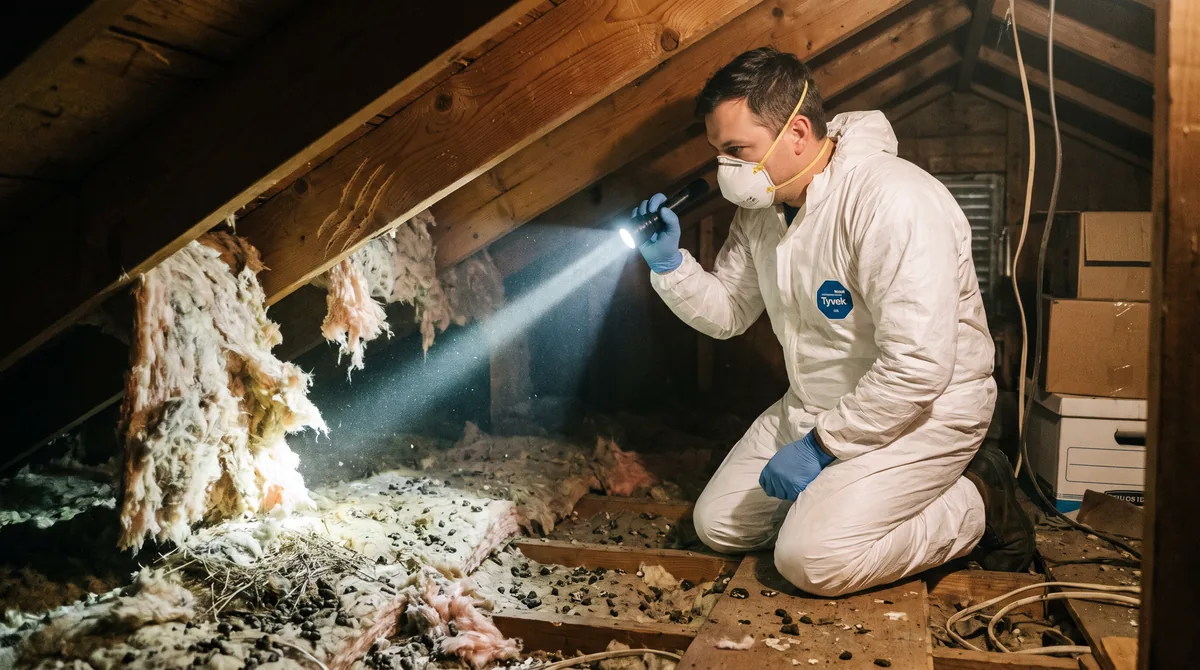
More Than Just a Nuisance Animal
A raccoon in the attic or chimney is usually first treated as a noise problem or a property-damage problem. But raccoons carry several diseases that can pass to people through bites, scratches, or simple contact with their droppings and urine, which makes an infestation a health issue, not just a wildlife one.
Rabies: The Risk Most People Already Know
Raccoons are one of the more common carriers of rabies, a virus spread through the saliva of an infected animal, typically by a bite or scratch. Anyone bitten or scratched by a raccoon, or exposed to its saliva through a wound, should see a physician right away rather than wait to see if symptoms develop.
The Roundworm Risk Hiding in Raccoon Droppings
The bigger, less obvious risk comes from Baylisascaris procyonis, commonly called raccoon roundworm. It lives in the intestines of raccoons and sheds large numbers of eggs in their feces. Those eggs aren't dangerous the moment they're deposited, but after roughly two to four weeks in the environment, they become infectious to humans.
If those infective eggs are accidentally ingested, they can cause a serious disease that affects the nervous system. This is one of the main reasons raccoon droppings in an attic, chimney, or crawlspace shouldn't be swept up, brushed off, or handled without protection, since doing so can spread contaminated dust before anyone realizes there's a problem.
Giardia and Leptospirosis: Risks from Contact, Not Just Handling
Raccoons can also carry Giardia, a microscopic parasite that causes gastrointestinal illness, and Leptospirosis, a bacterial infection. Both spread when feces or urine contaminate soil, water, or surfaces that people or pets later come into contact with, not only through direct handling of the animal itself. That means a raccoon latrine near a porch, deck, or attic access point can be a source of exposure even if no one ever touches the raccoon.
Why Attics and Chimneys Are a Perfect Storm
Raccoons favor exactly the spots that make cleanup hardest to do safely: attics, chimneys, soffits, and crawlspaces with poor ventilation and tight quarters. Droppings and nesting material accumulate in insulation and hard-to-reach corners, and disturbing them without protection risks spreading contaminated dust through the rest of the house via the HVAC system or simple air movement.
What Trained Handling Actually Looks Like
Wetting droppings and nesting material down before removal, rather than sweeping or vacuuming them dry
Full protective equipment, including respiratory protection, since roundworm eggs and bacteria can be inhaled or ingested from airborne dust
Sealing contaminated insulation, nesting material, and debris for proper disposal
Cleaning and disinfecting the area afterward, since eggs and bacteria can persist in soil and on surfaces
This is exactly the kind of job we handle as part of our rodent and guano damage cleaning services. We treat raccoon droppings and nesting material with the same precautions we'd use for any wildlife biohazard, from initial containment through final cleanup.
When to Call a Professional
If you've found raccoon droppings, a latrine site, or an active den in an attic or chimney anywhere from Brewer and Bangor to Orono, Old Town, Ellsworth, or out toward Bar Harbor and Mount Desert Island, don't handle it yourself. If anyone in the home has been bitten, scratched, or has already handled raccoon waste without protection, see a physician first, then call us at (207) 989-4697 to have the site safely cleaned up and decontaminated.