Tear Gas Remediation: Why It's Not a Regular Cleanup Job
What Tear Gas Actually Does
Tear gas — most commonly one of two compounds, chlorobenzylidenemalononitrile (CN) or chloroacetophenone (CS) — is designed to do exactly what it sounds like: irritate the mucous membranes and skin on contact. That's what causes the coughing, tearing, and burning sensation associated with exposure. It's an effective tool for law enforcement in the moment, but that same chemical reactivity is what makes the aftermath such a difficult cleanup.
When tear gas canisters are deployed inside a structure, during a law enforcement action at a home or business for instance, they're often launched with enough force and heat to disperse the compound widely through the space. That heat matters — it helps the particles spread further and settle into surfaces throughout multiple rooms, not just wherever the canister landed.
Why It Doesn't Just Wipe Away
Tear gas residue behaves differently than ordinary soot or dust. It settles into porous materials — carpet, upholstered furniture, drapery, drywall — and can work its way into surfaces that look clean from a distance. Wiping down hard, nonporous surfaces removes some of it, but residue trapped in fabric, padding, and building materials tends to stay behind.
That trapped residue doesn't necessarily stay put, either. Given enough time, and sometimes enough heat from sunlight or a furnace kicking on, tear gas particles can re-release into the air, a process often called off-gassing. This is especially common with exposed wall studs, if a canister punched through drywall, and with porous furnishings that were cleaned rather than removed. A space can look and smell fine on day one and still cause noticeable irritation weeks later if the underlying residue wasn't fully addressed.
What Safe Remediation Actually Requires
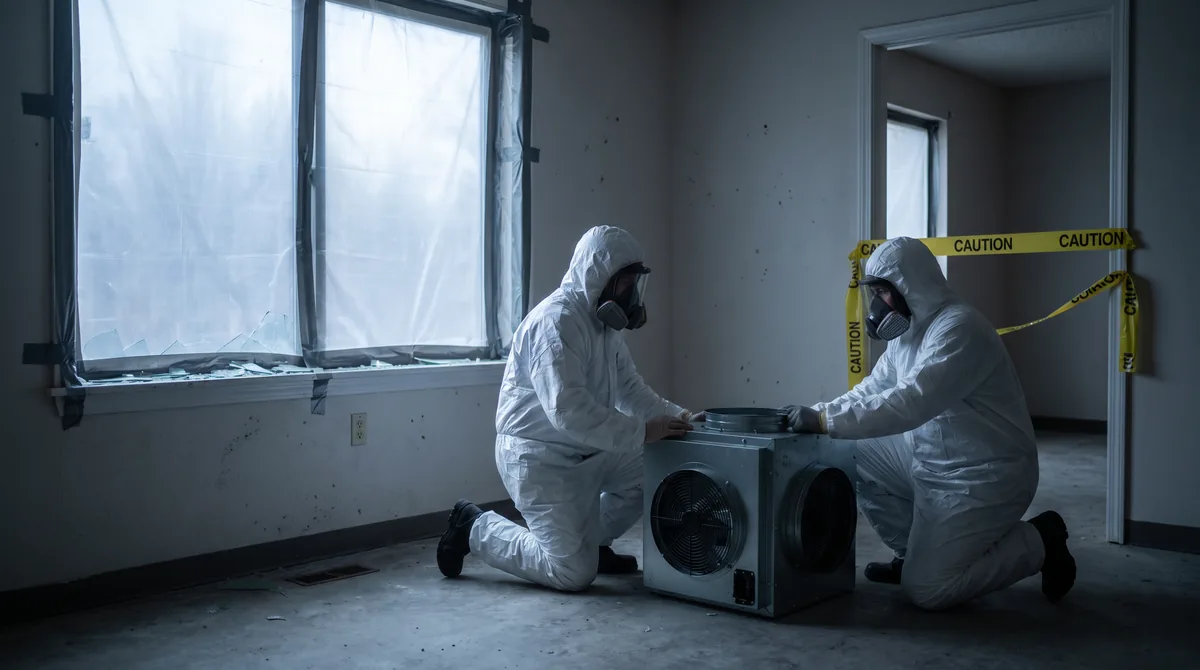
Because tear gas residue is a genuine respiratory and skin irritant, remediation crews don't approach it like a standard post-incident cleanup. Proper protective equipment, encapsulated suits and respirators, is non-negotiable for anyone entering an affected space. Beyond personal protection, the work itself has to be methodical:
Rooms are sealed off and worked one at a time to prevent residue from migrating into areas that have already been cleaned
HEPA vacuuming removes as much particulate residue as possible from surfaces before any wet cleaning begins
Specialized cleaning agents formulated for tear gas residue are used rather than general-purpose cleaners
Air vents and openings between rooms are covered during the process so airflow doesn't carry residue from a dirty room into a clean one
Some Materials Simply Can't Be Saved
One of the harder conversations in tear gas remediation is telling a property owner that a couch, a section of carpet, or part of a wall needs to be disposed of rather than cleaned. Heavily contaminated porous materials often can't be fully decontaminated no matter how thoroughly they're treated, since residue soaks deep into their fibers or structure. Attempting to clean and keep them usually just means the irritation comes back later. In many cases, removing and properly disposing of the worst-affected materials is what actually gets a property back to livable or usable condition faster.
Don't Skip the Ductwork
If the property has forced-air heating or cooling, the HVAC system needs its own attention. Ducts that ran while a tear gas incident occurred, or that circulated air through affected rooms afterward, can hold onto residue the same way they hold onto ordinary dust. A qualified HVAC company should clean the duct system as part of the overall remediation; otherwise, turning the system back on can redistribute the exact contamination the rest of the cleanup just removed.
When to Call a Professional
Tear gas remediation isn't a project for standard cleaning products or a rental carpet cleaner — it calls for trained crews, the right protective equipment, and a methodical, room-by-room process. If your home or business in the Brewer, Bangor, Ellsworth, or greater Penobscot and Hancock County area was affected by a law enforcement incident involving tear gas, our biohazard, trauma, and crime scene remediation team can assess the property and walk you through what needs to happen next. Call us at (207) 989-4697 as soon as it's safe to do so.